
Pakistan’s Counter Terrorism Architecture: From Reactive Posture to Strategic Framework
Pakistan has one of the most extensive counterterrorism governance frameworks in the developing world. Its construction was neither planned nor linear. It emerged from successive crises, each exposing gaps the previous framework had failed to close. Between 2014 and 2022, Pakistan produced four major policy documents, including two National Internal Security Policies, a revised National Action Plan, and a National Security Policy, alongside a range of institutions, coordinating bodies, and dedicated operational commands. Understanding what that architecture consists of, how it was built, and what each iteration was designed to correct is essential for evaluating Pakistan’s counterterrorism record. This factsheet traces that evolution from the fractured pre-2014 posture through to the National Security Policy of 2022, with particular attention to how the institutional design changed at each stage and what drove those changes.
2014
National Internal Security
Policy
Policy
2018
National Internal Security
Policy
Policy
2021
Revised National
Action Plan
Action Plan
2022
National Security
Policy
Policy
Before the Framework: A Reactive and Divided State
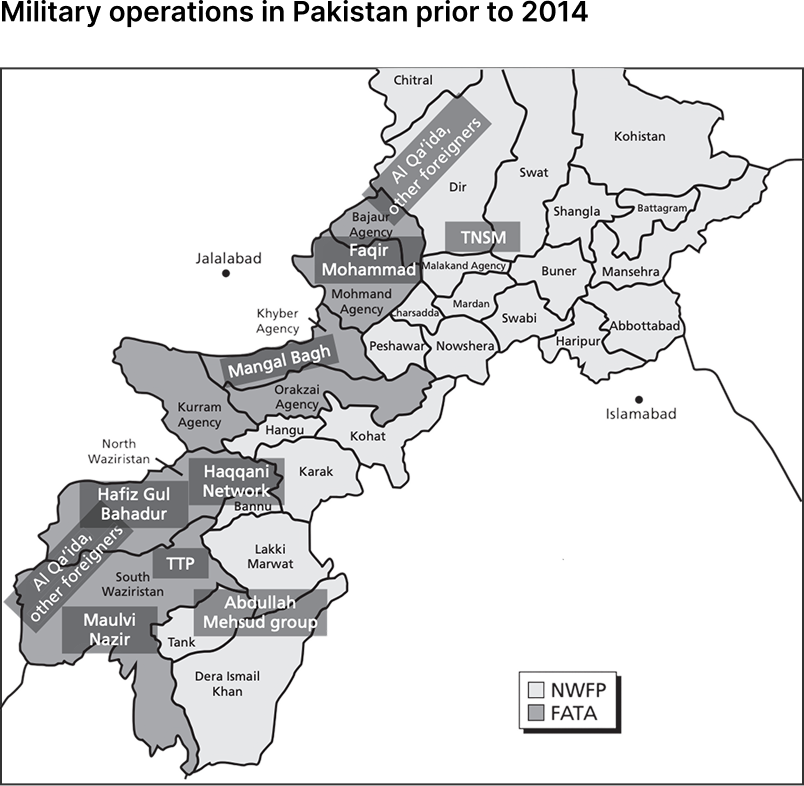
Prior to 2014, Pakistan’s response to terrorism was fragmented and politically contested, with no unified strategic framework guiding the security apparatus. Inter-agency coordination was chronically weak. Military operations in Swat, South Waziristan, and other areas of the tribal belt were reactive in nature and lacked an institutional foundation. Non-kinetic measures were largely absent from the response. On the political level, parties were divided between those who supported military operations and those who favoured negotiations with militant groups. This division undermined public consensus and made it difficult to sustain resource-intensive campaigns over time. Following any military operation, terrorism subsided for a period only to re-emerge with greater intensity.

The National Counter Terrorism Authority (NACTA) was established in 2008 to coordinate counterterrorism and counter-extremism efforts across federal and provincial institutions. Its mandate covered intelligence collation, policy formulation, and inter-agency coordination. Despite being given autonomous statutory status under the NACTA Act in 2013, the institution remained largely dysfunctional in its early years. Bureaucratic disputes between the Ministry of Interior, which sought to treat NACTA as a subsidiary body, and the institution’s statutory autonomy under the Prime Minister paralysed its functioning. The Board of Governors, headed by the Prime Minister, convened no meetings under successive prime ministers. The APS attack itself was partly a product of this coordination failure: an intelligence-based threat alert about a possible attack on an army-run educational institution in Khyber Pakhtunkhwa had been issued on 28 August 2014 and was not acted upon.

The National Internal Security Policy 2014: The First Framework
Pakistan’s maiden National Internal Security Policy (NISP), introduced in 2014, was the first attempt to give the state a comprehensive and coherent internal security framework. The policy identified both traditional and non-traditional threats and called explicitly for a transition from a reactive to a proactive posture. It acknowledged that the country could not afford to deal with the terrorist threat in a reactive and disjointed manner.
The NISP 2014 organized its response around a National Internal Security Framework built on four pillars: dialogue, isolation, deterrence, and capacity building of the criminal justice system and police. It envisioned NACTA as the central coordinating body and proposed a suite of new institutions: a Directorate of Internal Security, an Intelligence and Analysis Centre, a National Internal Security Operations Centre, and Rapid Response Forces at federal and provincial levels. Counter Terrorism Departments were to be reorganized in every province, with uniform structure and unified command, each comprising intelligence, operations, investigations, and technical sections. These proposals addressed structural weaknesses that had defined the pre-2014 security apparatus: fragmented intelligence and inconsistent law enforcement capacity, compounded by an absence of unified command.
The NISP 2014 was a conceptual advance on what had come before. It represented a recognition at the policy level that the state’s security posture needed fundamental reform. In practice, however, its proposals remained largely unimplemented. Detailed delivery mechanisms were underdeveloped, and the new institutions it envisaged were not built before the APS attack forced a different kind of response.
The NISP 2014 organized its response around a National Internal Security Framework built on four pillars: dialogue, isolation, deterrence, and capacity building of the criminal justice system and police. It envisioned NACTA as the central coordinating body and proposed a suite of new institutions: a Directorate of Internal Security, an Intelligence and Analysis Centre, a National Internal Security Operations Centre, and Rapid Response Forces at federal and provincial levels. Counter Terrorism Departments were to be reorganized in every province, with uniform structure and unified command, each comprising intelligence, operations, investigations, and technical sections. These proposals addressed structural weaknesses that had defined the pre-2014 security apparatus: fragmented intelligence and inconsistent law enforcement capacity, compounded by an absence of unified command.
The NISP 2014 was a conceptual advance on what had come before. It represented a recognition at the policy level that the state’s security posture needed fundamental reform. In practice, however, its proposals remained largely unimplemented. Detailed delivery mechanisms were underdeveloped, and the new institutions it envisaged were not built before the APS attack forced a different kind of response.


The National Action Plan 2014: Consensus in Crisis

The massacre at the Army Public School in Peshawar on 16 December 2014, in which over 130 schoolchildren were killed, broke through the political divisions that had prevented a coherent national response to terrorism. Parties that had long supported negotiations with the Tehreek-e-Taliban Pakistan were compelled to abandon that position in the face of national outrage. The attack has been described as bridging the civil-military divide on counterterrorism and eliminating the political differences between competing parties. That consensus produced the National Action Plan (NAP), a 20-point counterterrorism roadmap approved by Parliament on 24 December 2014.

To oversee delivery at the sub-national level, an extensive implementation mechanism was created. Ministerial committees operated at the federal level; provincial apex committees brought together chief ministers, corps commanders, and senior civilian and military officials. This arrangement represented a structural improvement over the pre-NAP landscape of overlapping mandates and absent coordination. For the first time, there was a single operational document that the entire political and military leadership had formally endorsed, and a set of mechanisms, however imperfect, to track progress against it.
NACTA as Coordinator: Progress and Persistent Limits
Post-NAP, NACTA was made functional as the main coordinating agency for counterterrorism and counter-extremism policy. Provincial committees submitted monthly reports, and NACTA conducted six-monthly reviews. A CVE wing was established, and after 34 rounds of consultation with over 300 stakeholders, NACTA produced National Counter Extremism Policy Guidelines covering rule of law, education reform, rehabilitation, media engagement, and community involvement. A Joint Intelligence Directorate was established to bridge intelligence sharing among federal and provincial law enforcement agencies. A National Task Force for Countering the Financing of Terrorism was created within NACTA, comprising 27 organizations, to coordinate the disruption of militant financing streams. Youth engagement programmes were initiated with universities and seminaries across the country.

NACTA’s ability to act as a genuinely whole-of-government coordinator, rather than simply a federal policy think tank, was limited by its lack of provincial extensions and absence of operational authority over provincial counter-terrorism departments.
NISP 2018 and the Turn Toward Non-Kinetic Governance
Formulated after five years of NAP implementation, the National Internal Security Policy 2018 acknowledged that the hard security gains of the previous period needed to be consolidated through sustained non-kinetic interventions. Terror-related violence had declined substantially, and the NISP 2018 shifted its primary emphasis toward soft measures accordingly.
Its organizing framework was a six-pillar strategy: Reorient, Reimagine, Redistribute, Reconcile, Recognize, and a Regional approach. The policy articulated an expanded conception of security. Peace, in this framing, meant the presence of conditions for socio-economic and political development rather than simply the suppression of violence. It identified the structural drivers of insecurity, including youth alienation, exclusionary identity narratives, regional inequality, lack of social justice and rule of law, and lack of accountability, and argued that counterterrorism could not be sustained without addressing them.
The Paigham-e-Pakistan fatwa, signed by hundreds of religious scholars, was endorsed as a step toward a national counter-narrative. NACTA was tasked with developing a comprehensive national narrative on extremism. The policy also recognized the enhanced provincial role following the Eighteenth Amendment, proposing an Inter-Provincial Coordination Committee to improve federal-provincial alignment on security delivery.
Its organizing framework was a six-pillar strategy: Reorient, Reimagine, Redistribute, Reconcile, Recognize, and a Regional approach. The policy articulated an expanded conception of security. Peace, in this framing, meant the presence of conditions for socio-economic and political development rather than simply the suppression of violence. It identified the structural drivers of insecurity, including youth alienation, exclusionary identity narratives, regional inequality, lack of social justice and rule of law, and lack of accountability, and argued that counterterrorism could not be sustained without addressing them.
The Paigham-e-Pakistan fatwa, signed by hundreds of religious scholars, was endorsed as a step toward a national counter-narrative. NACTA was tasked with developing a comprehensive national narrative on extremism. The policy also recognized the enhanced provincial role following the Eighteenth Amendment, proposing an Inter-Provincial Coordination Committee to improve federal-provincial alignment on security delivery.


Revised NAP 2021 and the National Security Policy 2022
The Revised National Action Plan of 2021 represented a formal acknowledgment that the original NAP’s concentration on kinetic measures had left significant gaps. The revised plan reorganized the strategy into two explicit domains.
Non – Kinetic
1. CTD capacity building
2. CVE policy formulation
3. Madrassa registration and regulation
4. Balochistan reconciliation process
5. Governance reform in KP’s merged districts
6. Criminal justice system reform
7. Legislative oversight of espionage and subversion
8. Management of Afghan refugees
Kinetic
1. Eliminating militant networks
2. Countering terrorist use of media and cyberspace
3. Preventing sectarian violence
4. Disrupting financing and organized crime

The conceptual separation between the two domains was more precise than in 2014, and the non-kinetic agenda more detailed.
The National Security Policy 2022, Pakistan’s first comprehensive national security framework, marked the most significant conceptual departure from the security-centric frameworks preceding it. It placed citizens rather than the state at the centre of national security and identified economic well-being and social justice, alongside human development, as fundamental security imperatives. The policy shifted the strategic paradigm from geo-politics to geo-economics and framed regional connectivity as a security tool. It also acknowledged explicitly that Pakistan could not afford policy reversals, identifying policy continuity through democratic processes as a security requirement in itself. This was an admission that the chronic absence of such continuity had created strategic vulnerability.

Conclusion
Pakistan built its counterterrorism architecture iteratively, driven by crises and shaped by the institutional and political realities of each period. The NISP 2014 provided the first comprehensive framework; the APS attack and NAP generated the political consensus to act; NISP 2018 began addressing the imbalance between hard and soft measures; and the revised NAP 2021 and NSP 2022 pushed that recalibration further still. Each iteration acknowledged what the one before had left unresolved. The result is a policy architecture that, on paper, addresses the full spectrum of the terrorist threat, encompassing both its organizational manifestations and its structural roots. The strength of that architecture, however, lies entirely in the capacity of the institutions assigned to implement it. Pakistan’s renewed security challenges, visible in the resurgence of militancy from 2021 onwards, make the gap between the framework and its delivery the defining question for the country’s internal security in the years ahead.