TARGETING WATER IN WAR
water under fire
The 2026
Iran Conflict
water
under
fire
The 2026 Iran Conflict
In the early hours of 10 June 2026, two drinking water reservoirs in Bemani district, Sirik County – a remote stretch of Iran’s Hormozgan province – were destroyed. Analysis of satellite imagery and munitions remnants identified a US-made GBU-39 precision bomb. Iran filed formal war crime cases in both domestic and international judicial bodies. The United States had not officially acknowledged the strike.
The region's temperatures routinely exceed 45°C
Water for more than 20,000 residents cut off
Strike impacted 10 surrounding villages
It was not the first time water had entered the crossfire. The conflict, which began on 28 February 2026, had drawn water infrastructure into its logic from almost the very start.
A Timeline of Attacks
The stakes are enormous. The six Gulf Cooperation Council (GCC) states – Bahrain, Kuwait, Oman, Qatar, Saudi Arabia, and the UAE – operate over 3,400 desalination plants collectively producing 22.67 million cubic metres of water per day, representing 33 percent of global daily production capacity. Qatar derives 99 percent of its drinking water from desalination; Bahrain over 90 percent; Kuwait, Oman and Saudi Arabia between 70 and 90 percent. As the Pacific Institute’s Peter Gleick noted in the Bulletin of the Atomic Scientists, a 1983 CIA assessment had already warned that disruption of Gulf desalination facilities “could have more serious consequences than the loss of any other industry or commodity.” That warning has never been more relevant.
Water as a Weapon: A Historical Pattern
The weaponisation of water infrastructure is not a new phenomenon. Across centuries of conflict, the destruction of dams, dikes, and water systems has served as a tool of war - and almost invariably, it is civilians who bear the greatest cost.
hover on images
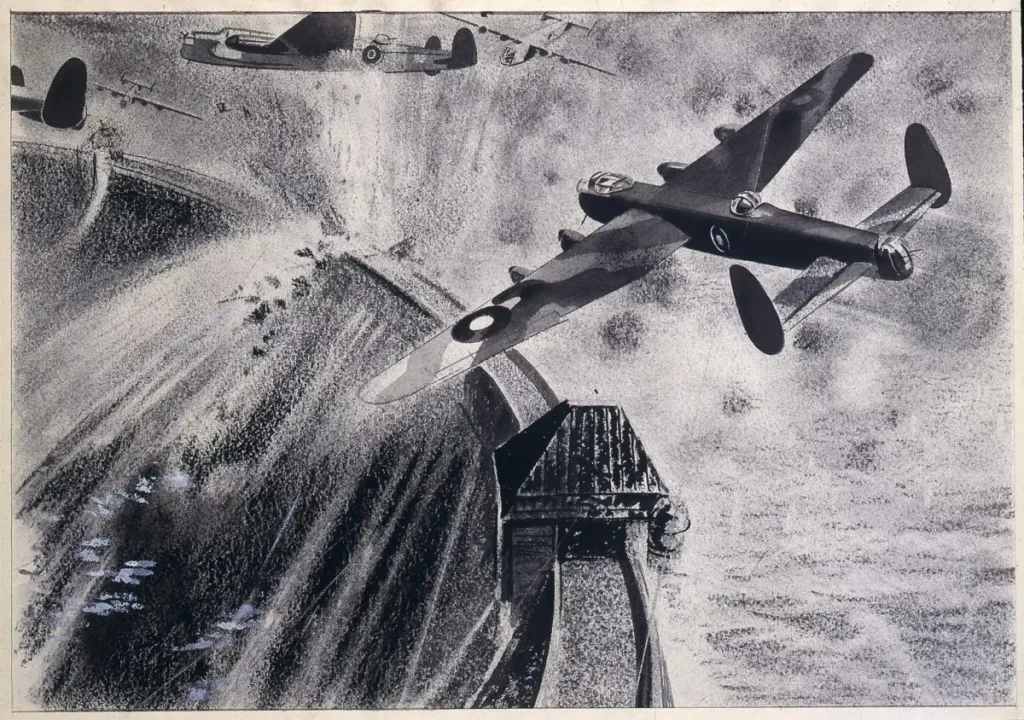 On the night of 16-17 May 1943, Britain's RAF 617 Squadron carried out Operation Chastise - the famous "Dambusters" raid - deploying bouncing bombs designed by Barnes Wallis to breach the Möhne and Eder dams in Germany's Ruhr valley. The Möhne breach sent catastrophic flooding through the valley; the Sorpe dam sustained only minor damage. An estimated 1,600 civilians were killed - roughly 600 Germans and approximately 1,000 enslaved labourers, predominantly Soviet prisoners of war. Factories, mines, and two hydroelectric stations were destroyed, and industrial production was disrupted until September 1943. The raid is frequently cited in IHL commentary as precisely the kind of attack that later codified law - particularly Article 56 of Additional Protocol I - was designed to prohibit.
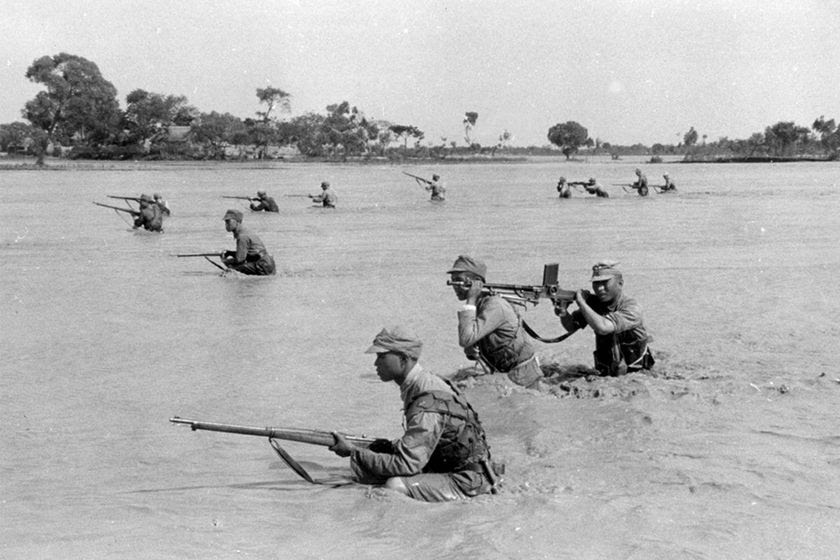 In June 1938, Chinese Nationalist forces breached the Yellow River dikes at Huayuankou, Henan, during the Second Sino-Japanese War. The intention was to use floodwaters as a substitute for soldiers - a scorched-earth barrier to slow the Japanese advance. The immediate drowning deaths numbered between 30,000 and 89,000. Accounting for famine and plague in the inundation's aftermath, total civilian deaths reached between 400,000 and 500,000. Five million people lived on flooded land for nearly a decade until the dikes were repaired in January 1947. The strategic gain was temporary; the civilian cost was catastrophic and permanent.
 During the Gulf War, Iraqi forces deliberately destroyed much of Kuwait's desalination capacity and dumped millions of barrels of oil into the northern Persian Gulf, jeopardising the seawater intakes of plants in Kuwait and Saudi Arabia. After liberation, Kuwait was forced to cut household water services to four days a week while relying on contracted tanker ships and hundreds of trucks to supply its population. Coalition forces also targeted Iraq's electrical grid - on which water treatment depended - with consequences that extended far beyond the battlefield. The pattern of infrastructure destruction leading to cascading civilian harm through waterborne disease became a defining feature of the conflict's humanitarian toll.
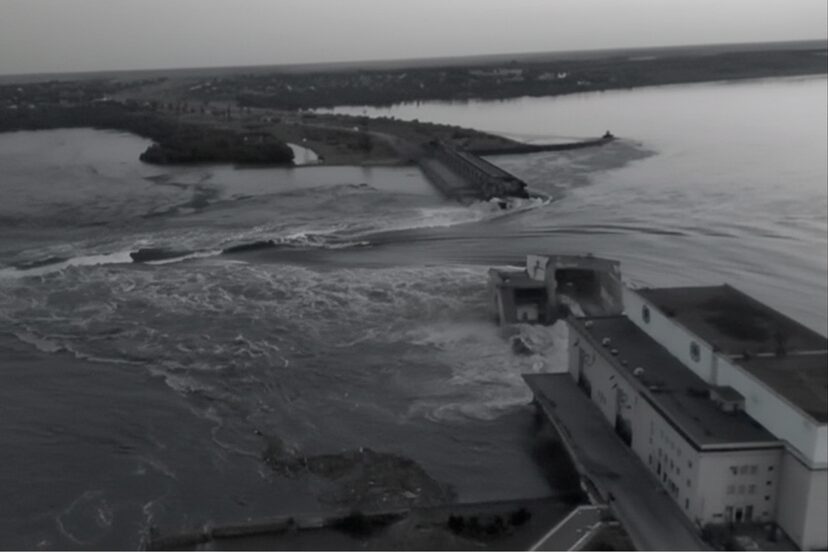 On 6 June 2023, the Kakhovka Dam on the Dnipro River - under Russian military control - was breached. The dam was 30 metres tall and 3.2 kilometres long; the breach segment was approximately 85 metres. Flooding submerged 620 square kilometres across four oblasts. Russian authorities officially reported 59 deaths; local health workers and a volunteer grave digger from Oleshky told the Associated Press the death toll in that city alone was in the hundreds, with reporting suppressed by police and bodies relocated. Most experts concluded that Russian forces most likely destroyed the dam to hinder Ukraine's planned counteroffensive. Ukraine referred the case to the International Criminal Court, characterising the dam as a civilian object containing dangerous forces.
 Syria became a laboratory for water weaponisation. UNICEF documented that in Aleppo City in the summer of 2015, opposition groups cut the water supply more than 40 times, depriving approximately 1.5 million people of running water. ISIS at one point controlled roughly 60 percent of Syria's fresh and drinking water resources through seizure of the Tabqa and Tishrin dams. Government and allied strikes damaged the al-Khafsa water station - the main source for over 3.5 million people in the Aleppo region - causing months-long outages. Water was weaponised by all sides, with devastating public health consequences.
The Scale of Destruction: What Dam Failures Actually Mean
To understand why international law treats attacks on dams with particular gravity, it is necessary to reckon with what dam failures - deliberate or otherwise - actually produce. The numbers are staggering.
The Legal Framework
International humanitarian law addresses the targeting of water infrastructure through two principal provisions of the 1977 Additional Protocols to the Geneva Conventions - instruments that reflect the international community's recognition, after two world wars, that civilian survival cannot be separated from access to water.
Objects Indispensable to Survival
read →Works Containing Dangerous Forces
read →Customary Law and the Rome Statute
read →A Critical Gap
read →The 2026 Iran conflict has brought the law of water in warfare into sharper focus than any conflict since the 1991 Gulf War.
Explicit threats to destroy the desalination infrastructure upon which approximately 100 million people depend have been issued by parties to an active armed conflict - and, in the case of the Bemani reservoirs, precision strikes on civilian water infrastructure appear to have been carried out.
Iran has initiated formal war crimes proceedings. The UN University's Middle East lead described attacks on desalination infrastructure as "absolutely a war crime." International legal experts invoked Article 54 and the prohibition on collective punishment.
The pattern of action - and of impunity - mirrors what was documented in Gaza from October 2023, where the World Bank found that by August 2024, 84.6 percent of water, sanitation, and hygiene infrastructure had been destroyed or damaged.
Water is not simply a resource at stake in these conflicts. Rather, it is the mechanism through which civilian populations can be made to suffer without the use of conventional military force against persons.
The law is clear.
What remains is the will — and the capacity — to enforce it.